Table of Contents
Features of the Dual-Cylinder Four-Stroke Travel Speed 4Km Tracked Remote Controlled Flail Mulcher
 The dual-cylinder setup provides a significant advantage in torque delivery, making it an ideal choice for challenging terrains. The machine’s ability to maintain high performance even under load is essential for achieving optimal results in vegetation management and other demanding applications.
 The intelligent servo controller plays a crucial role in the operation of the dual-cylinder four-stroke travel speed 4Km tracked remote controlled flail mulcher. By precisely regulating motor speed and synchronizing the left and right tracks, operators can navigate the machine smoothly, reducing the need for constant manual adjustments during use.
Versatility and Performance of the Dual-Cylinder Four-Stroke Travel Speed 4Km Tracked Remote Controlled Flail Mulcher
 Designed for versatility, the dual-cylinder four-stroke travel speed 4Km tracked remote controlled flail mulcher features interchangeable front attachments. This innovative design allows users to equip the machine with a 1000mm-wide flail mower, a hammer flail, or even a forest mulcher, making it suitable for a variety of tasks such as heavy-duty grass cutting, shrub clearing, and vegetation management.
 The inclusion of electric hydraulic push rods enables remote height adjustment of these attachments, adding to the ease of use. Operators can quickly adapt the machine to different working conditions without having to leave the comfort of their control station.
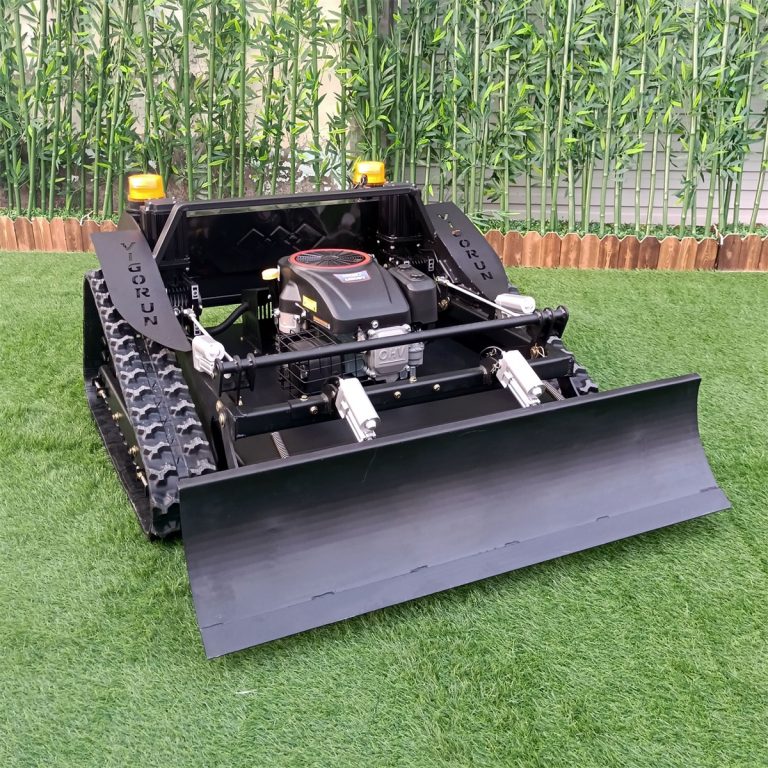
 This mulcher excels in snow removal as well, with options for an angle snow plow or snow brush attachment. This capability ensures that it remains an invaluable tool throughout the year, effectively handling seasonal challenges.
The high reduction ratio of the worm gear reducer multiplies the already strong servo motor torque, providing immense output torque for climbing resistance. This feature, combined with mechanical self-locking capabilities during power loss, guarantees both safety and stability, allowing operators to confidently tackle slopes and rugged terrains.
This mulcher excels in snow removal as well, with options for an angle snow plow or snow brush attachment. This capability ensures that it remains an invaluable tool throughout the year, effectively handling seasonal challenges.
The high reduction ratio of the worm gear reducer multiplies the already strong servo motor torque, providing immense output torque for climbing resistance. This feature, combined with mechanical self-locking capabilities during power loss, guarantees both safety and stability, allowing operators to confidently tackle slopes and rugged terrains.